



Block Jack Dorsey AI layoffs have sent shockwaves through the financial technology sector, marking a definitive shift in how Silicon Valley balances human capital with emerging technology. Jack Dorsey, the co-founder and CEO of Block (formerly Square), has officially initiated a restructuring plan that eliminates approximately 4,000 positions. This aggressive downsizing is not merely a cost-cutting measure; it is the foundation of a billion-dollar bet on artificial intelligence (AI) to redefine the ecosystem of Cash App, Square, and TBD.
As we navigate the complexities of the 2026 economy, Block’s move signals a broader industry trend where operational efficiency is no longer about headcount, but about algorithmic precision. Dorsey’s vision is clear: a leaner, faster, and more automated Block that can outpace traditional banks and fintech competitors through deep AI integration.
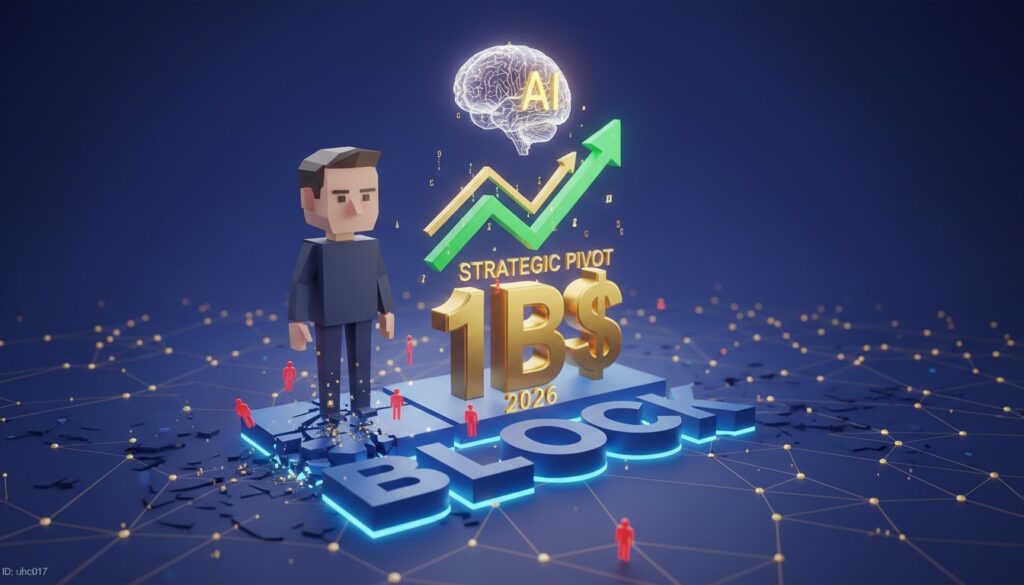
The Scale of Restructuring: 4,000 Roles Eliminated
The decision to reduce the workforce by 4,000 employees represents one of the most significant contractions in Block’s history. This reduction targets various departments, ranging from middle management to customer support and back-end operations.
Why Now? The Drive for Efficiency
For years, Block experienced exponential growth, particularly during the digital finance surge of the early 2020s. However, Dorsey has recently criticized the “bloat” that often accompanies rapid scaling. By streamlining the workforce, Block aims to achieve a “Rule of 40” performance—a metric where a company’s combined growth rate and profit margin exceed 40%.
- Objective 1: Reduce redundant administrative layers.
- Objective 2: Reallocate capital toward high-growth AI R&D.
- Objective 3: Standardize operations across Square and Cash App.
The $1 Billion AI Bet: What It Means for Investors
While the layoffs capture the headlines, the true story lies in where that saved capital is going. Block is committing over $1 billion into a multi-year AI roadmap. This investment focuses on several key pillars designed to automate the customer experience and financial decision-making processes.
Key Areas of AI Investment
- Generative AI for Merchants: Helping Square sellers automate marketing, inventory management, and customer interactions.
- Predictive Lending Models: Enhancing the “Buy Now, Pay Later” (Afterpay) and Square Loans algorithms to reduce default rates.
- Cash App Financial Assistants: Implementing hyper-personalized AI bots to manage user budgets and crypto investments.

Jack Dorsey’s Vision: Engineering a Self-Sustaining Ecosystem
Jack Dorsey has long been a proponent of decentralization and automation. His perspective is that humans should focus on creative problem-solving while AI handles the repetitive execution. The Block Jack Dorsey AI layoffs are a manifestation of this philosophy. In a memo to staff, Dorsey emphasized that the company must return to its “startup roots” where small, agile teams leverage powerful tools to achieve massive scale.
The Role of Decentralization and Bitcoin
AI is not the only technology in Dorsey’s crosshairs. The restructuring also aligns with Block’s commitment to Bitcoin. By automating core fintech services with AI, the company frees up resources to build out its decentralized web (Web5) and Bitcoin mining infrastructure. This synergy between AI and decentralized finance (DeFi) is what Dorsey believes will define the next decade of global commerce.
Impact on the Fintech Labor Market
The dismissal of 4,000 workers is a somber reminder of the changing job landscape in technology. Industry analysts suggest that Block is a “canary in the coal mine.” If a major player like Block can successfully replace thousands of roles with AI-driven systems while maintaining or increasing revenue, other fintech giants like PayPal and Stripe may follow suit.
Key Workforce Statistics for 2026:
- Skill Pivot: Demand for “AI Orchestrators” has risen by 150%.
- Displacement: Administrative roles in fintech have decreased by 22% year-over-year.
- Training: Block has reportedly offered AI-retraining stipends to a small percentage of remaining staff.
How This Affects Cash App and Square Users
For the average consumer, the Block Jack Dorsey AI layoffs may lead to a more seamless experience, though some fear a loss of the “human touch.”
- Speed: Transaction disputes and identity verification are expected to be resolved in seconds rather than days.
- Customization: Square merchants will see AI-generated insights that predict sales trends based on local events and weather.
- Security: Enhanced AI layers will likely decrease the frequency of account takeovers and phishing successes on Cash App.

Expert Analysis: The New Tech Paradigm
Financial experts from top-tier institutions suggest that Block’s pivot is necessary for long-term survival. As interest rates remain volatile and venture capital becomes more selective, profitability is king. By replacing fixed human costs with scalable software costs (AI), Block is effectively “future-proofing” its balance sheet.
“Block’s strategy is aggressive, but it reflects the reality of 2026. You either lead with AI or you are disrupted by it. Jack Dorsey is choosing to be the disruptor.” — Financial Times Analyst Report.
A New Era for Block Inc.
The Block Jack Dorsey AI layoffs represent a painful but perhaps inevitable evolution of the digital economy. By cutting 4,000 jobs to fund a $1 billion AI future, Jack Dorsey is betting that the efficiency of machines will provide more value to shareholders and users than the traditional corporate structure. As 2026 unfolds, the success of this transition will determine if Block remains a leader in the fintech revolution or becomes a cautionary tale of over-automation. For now, the world watches as the “billion-dollar bet” begins to play out in real-time.
