


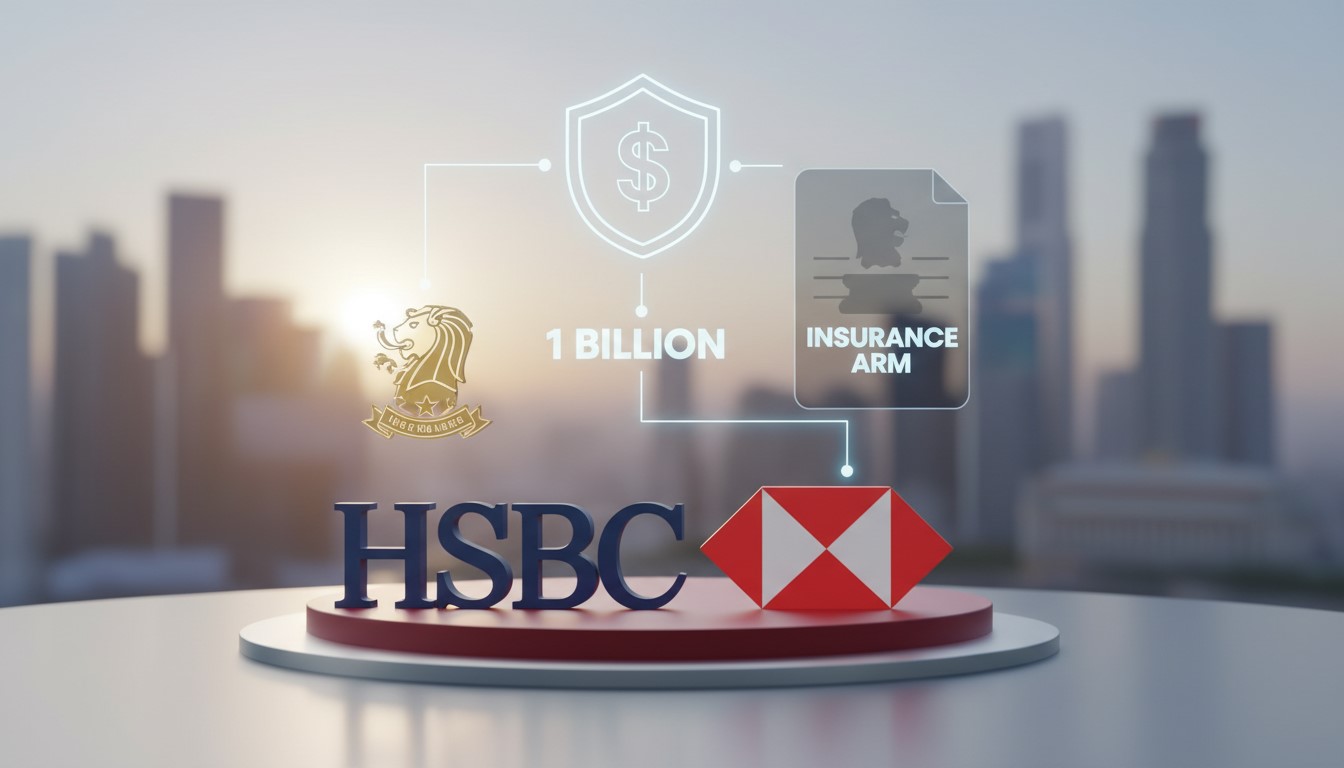
HSBC seeks to sell its Singapore insurance arm, a move currently valued at approximately US$1 billion, as the banking giant continues its aggressive multi-year strategy to streamline operations and pivot toward core high-growth markets. This potential divestment represents a significant shift in the Southeast Asian financial landscape, marking another milestone in the bank’s effort to simplify its sprawling global footprint.
As the financial sector enters 2026, the global banking industry is witnessing a trend of consolidation and specialization. For HSBC, the decision to explore a sale of its Singapore life insurance business is not merely a capital exercise but a strategic redirection under its latest leadership mandate.
The Strategic Rationale: Why HSBC is Divesting
The primary motivation behind the fact that HSBC seeks to sell its Singapore insurance arm lies in the bank’s broader objective to reduce complexity. Under the guidance of CEO Georges Elhedery, the lender has prioritized “simplification” to enhance shareholder returns and focus on its most profitable corridors.
Several factors are driving this specific divestiture:
- Capital Allocation: By offloading the insurance unit, HSBC can reallocate billions in capital toward its primary wealth management and wholesale banking divisions.
- Market Concentration: While Singapore remains a vital hub, the insurance sector is highly competitive with thin margins compared to high-net-worth wealth advisory.
- Regulatory Efficiency: Operating a full-scale insurance subsidiary requires significant regulatory capital buffers; a sale frees up these assets for more flexible use.
Financial Implications: The $1 Billion Valuation
Market analysts suggest the US$1 billion valuation is a fair reflection of the unit’s book value and future earnings potential. However, the final price will depend on the “bancassurance” agreements that are typically bundled with such sales.
Potential Buyers and Market Competition
The Asian insurance market remains a hotbed for M&A activity. Several global and regional players are expected to show interest in the Singaporean assets:
- Allianz SE: The German insurer has been actively expanding its footprint in Southeast Asia.
- Zurich Insurance Group: Looking to strengthen its life and health offerings in mature markets like Singapore.
- Local Giants: Companies such as Great Eastern or Income Insurance may see this as a consolidation opportunity to defend their home turf.

Comparing HSBC’s Global Exit Strategy
This move is not an isolated incident. HSBC has been systematically exiting non-core markets over the last three years to focus on its Asian “pivot.” The following table highlights recent major divestments by the group:
| Region | Transaction Status | Estimated Value |
|---|---|---|
| Canada | Completed (Sold to RBC) | US$10.1 Billion |
| France | Completed (Retail Banking) | US$1.2 Billion |
| Argentina | Completed (Sold to Grupo Galicia) | US$550 Million |
| Singapore | Strategic Review / Seeking Sale | US$1 Billion |
Strengthening Singapore as a Wealth Hub
Crucially, while HSBC seeks to sell its Singapore insurance arm, it is not leaving Singapore. On the contrary, the bank is doubling down on its Wealth and Personal Banking (WPB) operations in the city-state. Singapore serves as the bank’s regional bridge to the rest of Southeast Asia and a critical node for offshore wealth coming from Greater China.
By selling the manufacturing side of insurance, HSBC can transition into a distribution model. This means they will still sell insurance products to their clients but will do so through partnerships with third-party providers, reducing the operational burden of underwriting.
Impact on Policyholders and Employees
Whenever a major financial entity undergoes a sale, stakeholders naturally express concern. However, in the highly regulated Singaporean market:
- Policyholders: Existing contracts remain legally binding and are typically transferred to the new owner with no change in terms.
- Employees: Most M&A agreements in this sector include clauses for staff retention or integration into the purchasing entity.
- Services: Continuity of digital services and claims processing is a priority for the Monetary Authority of Singapore (MAS).

The Role of Digital Transformation in 2026
The insurance industry in 2026 is heavily influenced by Artificial Intelligence (AI) and InsurTech. Any buyer of HSBC’s unit will likely be looking to integrate these assets into a more digitally-native ecosystem. HSBC’s current infrastructure in Singapore is considered modern, making it an attractive “plug-and-play” asset for a global insurer looking to leapfrog technical debt.
Challenges to the Sale
Despite the attractive valuation, certain hurdles remain. The high-interest-rate environment of the past few years has changed the valuation models for life insurance portfolios. Additionally, geopolitical tensions in the region can occasionally dampen investor appetite for large-scale financial acquisitions.
Moreover, the Monetary Authority of Singapore (MAS) maintains stringent criteria for owners of systemic financial institutions. Any buyer will undergo a rigorous vetting process to ensure they have the capital adequacy and expertise to protect local consumers.
A Leaner Future for HSBC
The fact that HSBC seeks to sell its Singapore insurance arm is a testament to the bank’s commitment to its “pivot to Asia” while maintaining a lean, capital-efficient structure. By offloading this US$1 billion asset, HSBC is not signaling a retreat from the region, but rather a refinement of its mission to become the world’s leading wealth manager. For investors and clients alike, this move suggests a more focused, agile, and ultimately more profitable banking institution in the years to come.
