


The Marc Benioff SaaSpocalypse debate has recently dominated Wall Street discussions. Investors fear that artificial intelligence will destroy the Software-as-a-Service (SaaS) model. However, during the Q4 2025/FY2026 earnings call on February 25, 2026, Salesforce’s CEO made it clear that this narrative is fundamentally flawed. Rather than wiping out enterprise software, AI agents are making SaaS stronger than ever. Therefore, enterprise leaders must urgently understand this massive technological shift. In this article, we will explore exactly why the enterprise tech giant is thriving despite widespread market panic.
What Exactly is the Marc Benioff SaaSpocalypse?
The term refers to the mounting anxiety that autonomous AI systems will permanently replace traditional per-user subscription models. Consequently, many analysts predicted a catastrophic crash in enterprise software valuations. Furthermore, this unchecked fear has temporarily paralyzed many legacy technology investors.
The Threat to Per-Seat Licensing
For over two decades, SaaS companies have relied entirely on a per-seat pricing model. However, as AI agents become capable of completing tasks autonomously, companies theoretically need fewer human workers. As a result, fewer employees mean fewer individual software licenses. This dynamic initially sparked the global industry panic. The Marc Benioff SaaSpocalypse commentary specifically addresses this existential dread head-on. During his latest address, Benioff confidently reminded investors that this is not their first rodeo. Indeed, Salesforce has successfully survived the dot-com bubble, the 2008 financial crisis, and the massive shift to mobile computing.
Salesforce Q4 2026 Earnings: Defying the Gloom
To properly understand why the Marc Benioff SaaSpocalypse fears are entirely overblown, we must look at the hard data. Salesforce reported its Q4 earnings in late February 2026. Ultimately, the numbers were absolutely staggering. Furthermore, the financial metrics quickly shattered all prior analyst expectations.
Clearly, the verified data contradicts the prevailing doom narrative. Moreover, Salesforce strategically announced a massive $50 billion share buyback program. They also confidently raised their quarterly dividend to $0.44 per share. Ultimately, these calculated strategic moves demonstrate immense, unwavering financial stability.
The Nvidia Connection: Signaling AI Dominance
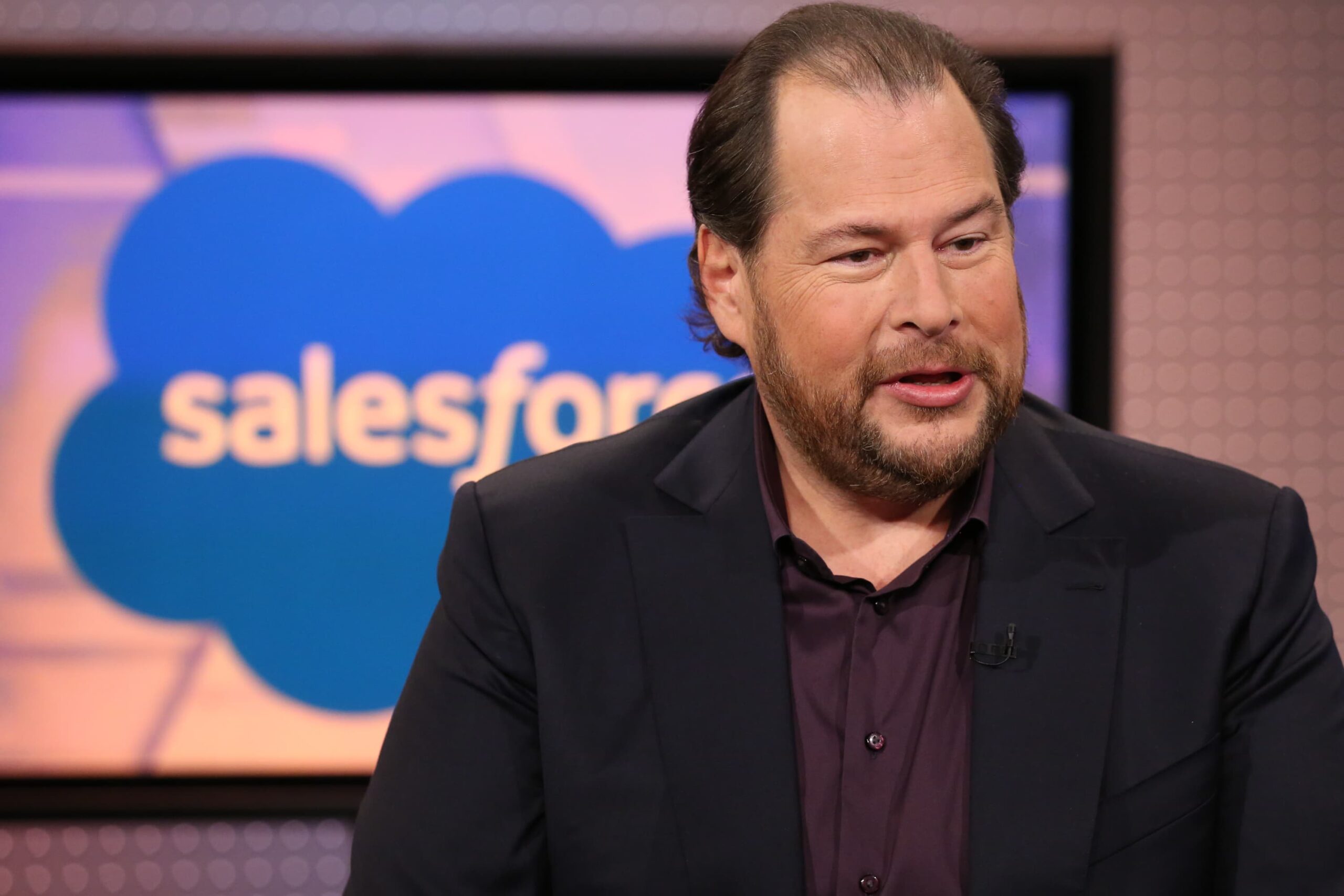
Interestingly, during the earnings call addressing the Marc Benioff SaaSpocalypse, the CEO made a subtle but incredibly powerful visual statement. Specifically, Marc Benioff appeared on camera wearing a signature black leather jacket. Notably, this directly echoes the highly iconic look of Nvidia CEO Jensen Huang.
Visualizing Technological Leadership
This specific sartorial choice was absolutely not a mere coincidence. Consequently, it served as a deliberate market signal to skeptical Wall Street analysts. It visually aligned Salesforce with the undeniable, undisputed hardware winners of the global AI revolution. Therefore, the company confidently positions itself as a core AI innovator, rather than just a legacy CRM platform. Furthermore, this bold confidence perfectly matched their aggressive $50 billion financial buyback announcement.
Enter the SaaSquatch: How AI Agents Improve SaaS
During the earnings call, the CEO intelligently used a colorful metaphor to dispel the Marc Benioff SaaSpocalypse rumors. He joked that the apocalyptic event would simply be eaten by the SaaSquatch. In essence, this mythical Bigfoot playfully represents the massive, undeniable appetite global companies have for agentic AI solutions.
Shifting to Agents as a Service
Instead of selling empty software shells, Salesforce is pioneering the concept of “Agents as a Service.” Consequently, customers are no longer just buying static databases. Instead, they are actively purchasing highly capable digital workers. This transition fundamentally changes the core SaaS value proposition.
Specifically, here are the primary ways AI agents are actively transforming Salesforce:
- Autonomous Resolution: AI agents can smoothly handle complex customer service tickets entirely without human intervention.
- Proactive Outreach: Intelligent sales agents autonomously generate verified leads and draft highly personalized outreach emails.
- Workflow Automation: Digital assistants seamlessly update critical business records across multiple enterprise databases.
- Enhanced Decision Making: Real-time data synthesis allows corporate executives to consistently make faster, better choices.
Agentic Work Units (AWUs): The New SaaS Metric
Another critical element of the Marc Benioff SaaSpocalypse defense strategy is the clever introduction of a brand-new success metric. Traditionally, AI companies measured success simply by raw token counts. However, isolated tokens do not correlate directly with tangible business value.
Therefore, Salesforce proudly introduced Agentic Work Units (AWUs).
- Precise Definition: An AWU strictly measures the actual, verified completion of a specific business task.
- Digital Tracking: It digitally records exactly when an AI agent successfully writes to a CRM record or formally closes a case.
- Modern Monetization: AWUs allow Salesforce to seamlessly charge based on successful outcomes rather than raw computing power.
- Massive Scale: The company efficiently processed an astonishing 19 trillion tokens last quarter, instantly converting them into actionable AWUs.
Competing in the AI Era: The Agentforce Advantage
To fully and completely dismantle the Marc Benioff SaaSpocalypse theory, the company showcased tremendous competitive momentum. Specifically, the newly launched Agentforce IT Service is making massive waves across the tech industry. Furthermore, it directly and aggressively challenges established legacy systems.
Taking on ServiceNow in ITSM
Salesforce ambitiously launched its ITSM (IT Service Management) product in October 2025. In just a few short months, they successfully secured over 180 massive enterprise customers. Notably, Benioff explicitly highlighted that major global brands are rapidly migrating away from competitors like ServiceNow. For instance, reputable companies like SunRun and Cornerstone have already made the permanent switch. This aggressive market capture strongly proves that the software model is merely evolving, not dying.
Real-World Customer Validation in 2026
Customer testimonials currently provide the absolute strongest counter-argument to the Marc Benioff SaaSpocalypse panic. During the February 2026 earnings presentation, several high-profile CEOs publicly praised Salesforce’s innovative new direction. Consequently, this genuine validation heavily reassured nervous stakeholders.
Key industry leaders who strongly endorsed the AI-agent model include:
- SharkNinja: Their CEO openly praised the seamless, highly efficient integration of AI agents into their global consumer product lifecycle.
- Wyndham Hotels: The hospitality giant effectively uses Agentforce to smoothly manage complex booking inquiries and instantly improve overall guest satisfaction.
- SaaStr: The prominent SaaS community leader publicly validated the inevitable, highly profitable shift toward outcome-based software pricing.
Moreover, these explicit customer testimonials consistently validate the outcome-based pricing strategy. Consequently, business leaders are completely willing to pay premium rates for AI if it guarantees tangible results. Therefore, the old software model is simply transforming into a much more valuable, hyper-efficient digital workforce ecosystem.
Strategic Positioning: Owning the AI Tech Stack
Why is Salesforce surviving the Marc Benioff SaaSpocalypse while others struggle? The definitive answer lies heavily in their brilliant architectural strategy. Unlike some vulnerable competitors who simply build basic wrappers around OpenAI’s public models, Salesforce heavily owns the vast majority of its tech stack.
Furthermore, they deliberately treat external AI model makers as foundational, easily interchangeable utilities. Consequently, Salesforce firmly controls both the proprietary business data layer and the final workflow execution layer. This highly secure approach ensures that critical enterprise customer data remains perfectly protected. In addition, it completely prevents underlying third-party AI models from commoditizing the main SaaS platform.
In conclusion, the global enterprise software industry is certainly undergoing a massive, unprecedented paradigm shift. However, the much-feared Marc Benioff SaaSpocalypse is ultimately an illusion. Traditional per-seat licensing may slowly decline over the next dynamic decade. Yet, highly lucrative outcome-based pricing models tied directly to functional AI agents will rapidly and profitably replace it.
Companies that stubbornly fail to adapt will inevitably face permanent obsolescence. Conversely, forward-thinking platforms like Salesforce that fully embrace true AI integration will thrive spectacularly.
Frequently Asked Questions (FAQ)
What does the Marc Benioff SaaSpocalypse mean?
The Marc Benioff SaaSpocalypse refers to the widespread investor fear that autonomous AI agents will completely destroy traditional SaaS companies. Specifically, financial analysts deeply worried that AI would rapidly eliminate the inherent need for per-seat human software licenses. However, Salesforce has definitively proven this persistent fear is entirely unfounded.
How did Salesforce perform financially in Q4 2026?
Salesforce performed exceptionally well, thoroughly defying all major market doom. Furthermore, they officially reported $10.7 billion in quarterly revenue, marking a highly impressive 13% year-over-year increase. Additionally, they proudly announced a massive $50 billion corporate share buyback program.
What are Agentic Work Units (AWUs)?
Agentic Work Units (AWUs) represent a profoundly revolutionary new SaaS metric natively introduced by Salesforce. Instead of blindly counting raw AI tokens, an AWU strictly measures the successful completion of a real, tangible business task. Consequently, this innovation allows for highly accurate, easily justifiable outcome-based monetization.
Will AI agents completely replace traditional CRM software?
No, AI agents will absolutely not replace core CRM software. Instead, they fundamentally enhance and elevate it. Consequently, static platforms are rapidly transforming into dynamic Agents as a Service. Therefore, companies will continue to heavily utilize centralized CRM systems, but the underlying daily tasks will be executed autonomously by sophisticated AI.
How is Salesforce competing with ServiceNow in 2026?
Salesforce strategically launched its Agentforce IT Service specifically to directly challenge ServiceNow in the lucrative ITSM market. Notably, within just a few short months, they successfully captured over 180 massive enterprise clients. Therefore, they are aggressively expanding their overall market footprint and actively disrupting legacy competitors.
