


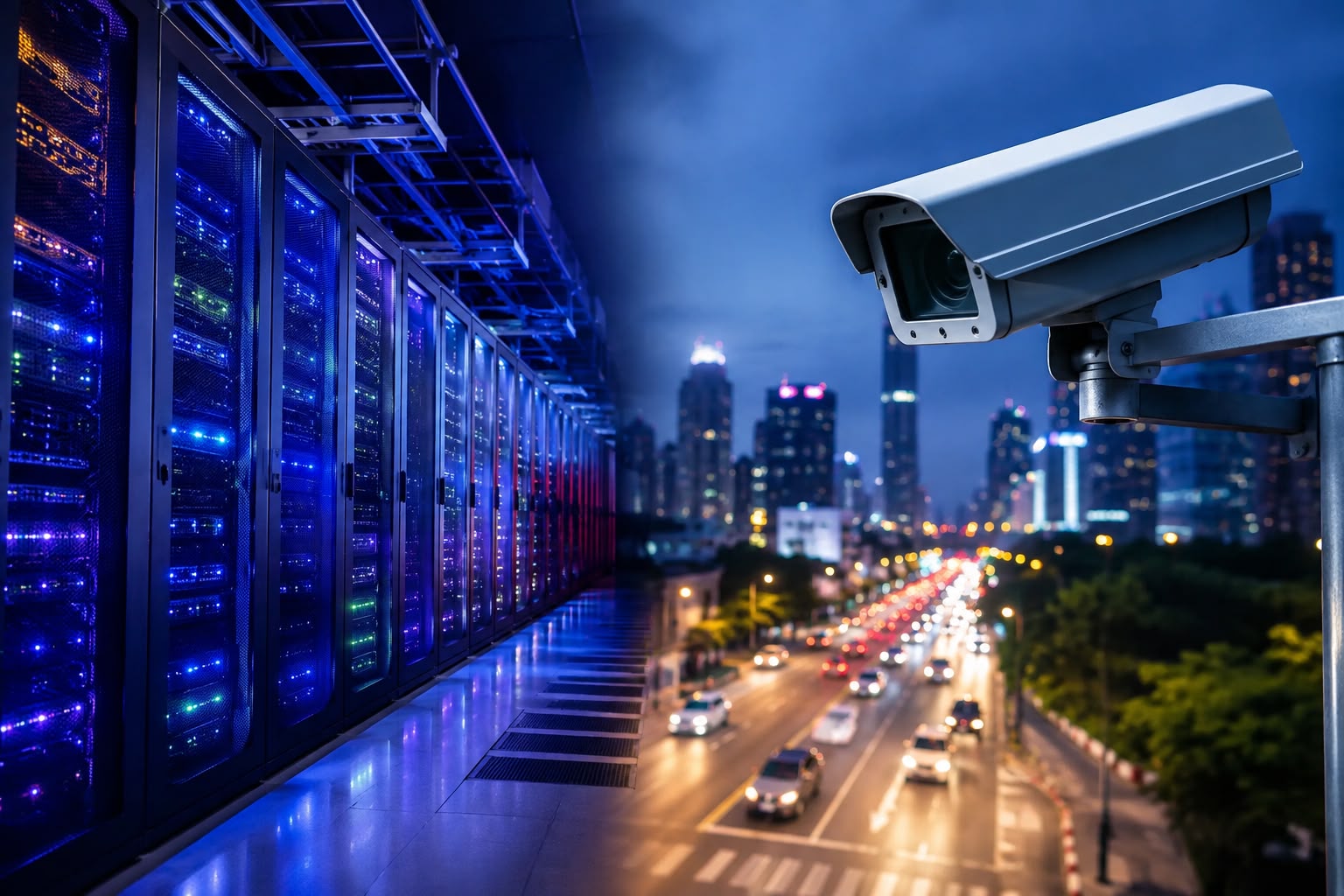
AI data centers and surveillance cameras are becoming two of the most debated technologies in the United States. Although they serve very different purposes, both are facing growing public scrutiny over privacy, transparency, infrastructure, and the role of technology in local communities.
Across parts of the United States, residents and local officials are increasingly questioning two very different-looking technologies: massive data centers built to power artificial intelligence and automated license plate reader cameras used for public safety.
At first glance, these technologies appear unrelated.
Data centers are enormous facilities filled with computing equipment, while surveillance cameras sit on roads, poles, and intersections.
Yet both have become symbols of a broader concern: technology companies are making decisions that can have major consequences for communities without always giving those communities enough control over what happens next.
Recent reporting has highlighted growing opposition to both AI infrastructure and Flock Safety’s automated license plate readers, particularly around questions of privacy, transparency, local decision-making, and corporate accountability. (Gizmodo)
The AI Data Center Debate
The rapid expansion of generative AI requires enormous amounts of computing power.
That computing power has to live somewhere.
As AI companies and cloud providers expand their infrastructure, communities are being asked to accommodate large data centers that can consume substantial amounts of electricity, require significant infrastructure investment, and potentially affect local water and environmental resources.
For technology companies, these facilities represent the backbone of the next generation of computing.
For residents, however, the question is increasingly simple:
What does the community receive in return?
Economic development, construction jobs, tax revenue, and technological investment can provide real benefits. But residents may also worry about electricity demand, water consumption, noise, land use, environmental effects, and whether promised economic benefits will justify the long-term costs.
This has transformed some data-center projects from routine infrastructure proposals into major political and community debates.
Surveillance Cameras Face a Similar Problem
Flock Safety’s automated license plate readers have become another major flashpoint.
The cameras use automated systems to capture information about vehicles, including license plates and vehicle characteristics. Supporters argue that the technology can help investigators locate stolen vehicles, find missing people, and solve crimes.
Critics see another possibility: a network capable of creating detailed records about where vehicles travel.
The debate has intensified as communities have learned more about how automated license plate reader networks can be searched, shared, and integrated into broader law-enforcement systems. The ACLU has described the technology as a form of mass surveillance and has documented growing opposition to Flock deployments across the country. (American Civil Liberties Union)
Recent reporting also shows that opposition is no longer limited to one political ideology. Residents and activists from different parts of the political spectrum have raised concerns about privacy and potential misuse. (Axios)
The Technology Is Not the Only Issue
An important distinction needs to be made.
The controversy is not necessarily about whether AI, cameras, or data centers are inherently bad.
The deeper issue is how these technologies are introduced and governed.
A surveillance camera may help police solve a serious crime. A data center may create jobs and provide infrastructure for valuable AI applications.
But the public increasingly wants answers to questions such as:
* Who controls the data?
* How long is information stored?
* Who can access it?
* Can information be shared with other agencies?
* What safeguards prevent abuse?
* Who audits the technology?
* Can residents challenge a deployment?
* What happens when the technology makes a mistake?
* Who is responsible when something goes wrong?
These questions are becoming just as important as the technology itself.
Privacy Has Become a Central Concern
Privacy is one of the biggest reasons for the backlash.
An individual license plate may be visible to anyone standing on a public road. But automated systems can change the scale of observation dramatically.
Instead of one person seeing one vehicle at one moment, a network can potentially collect and organize information from thousands or millions of observations.
That creates a different kind of privacy question.
The concern is not simply whether a camera can see a car.
It is whether technology can eventually make it possible to reconstruct patterns of movement, associations, and behavior on a scale that would have been difficult or impossible before.
Recent reporting has raised concerns about increasingly sophisticated AI tools connected to Flock’s surveillance ecosystem, including systems designed to analyze information from multiple sources. (WIRED)
That development has intensified the debate about where public safety ends and excessive surveillance begins.
Trust Can Disappear Faster Than Technology Can Expand
One of the biggest lessons from the current backlash is that technological adoption does not automatically create public acceptance.
Companies may believe that a product provides clear benefits.
Communities may see the same product differently.
For example, a surveillance system can be presented as a crime-fighting tool while residents see it as an infrastructure for permanent monitoring.
A data center can be presented as an investment in the future while nearby residents see it as a facility consuming local resources.
Both perspectives can exist simultaneously.
That is why communication matters.
When companies and governments make decisions first and explain them later, opposition can become significantly stronger.
Flock’s Growing Controversy
Flock Safety has become one of the clearest examples of this trust problem.
The company has faced growing criticism from communities concerned about surveillance, data sharing, and law-enforcement access.
Some cities have reconsidered or ended contracts, while others continue to defend the technology because of its potential benefits for public safety. Recent reporting indicates that dozens of cities have rejected or canceled Flock contracts in 2026, while some communities have replaced Flock systems with other surveillance vendors. (The Guardian)
This creates an important question:
If residents do not trust one surveillance company, will changing vendors actually solve the problem?
Not necessarily.
The broader issue is governance.
Replacing one company with another does not automatically establish meaningful privacy protections.
AI Infrastructure Has Its Own Trust Challenge
Data centers face a similar problem, although the technology is different.
The AI industry needs enormous infrastructure to support increasingly powerful models.
That infrastructure requires electricity, cooling systems, buildings, networking equipment, and physical space.
As demand increases, companies will need to build more facilities.
But communities will increasingly ask whether they should have a meaningful say in where those facilities are located and how their resources are used.
The future of AI therefore depends on more than better chips and faster models.
It also depends on whether the public accepts the physical infrastructure required to operate them.
The Political Dimension
The issue is becoming increasingly political.
Opposition to surveillance cameras and AI infrastructure is appearing in city councils, community meetings, activist campaigns, and broader political debates.
The unusual aspect is that criticism is not coming exclusively from one side of the political spectrum.
Privacy advocates, civil-liberties organizations, local residents, and people concerned about corporate power can arrive at similar conclusions for very different reasons.
The result is a growing coalition demanding more control over technology.
Recent coverage has described the convergence of anti-surveillance sentiment and resistance to AI infrastructure as part of a broader backlash against Silicon Valley’s influence. (The Wall Street Journal)
The Future May Depend on Transparency
Technology companies have an opportunity to respond before distrust becomes permanent.
That response cannot simply be another advertising campaign.
Communities increasingly want measurable guarantees.
That could include:
Clear data-retention policies.
People should know how long information is stored and when it is permanently deleted.
Independent oversight.
Technology used by governments should be subject to meaningful audits.
Public consultation.
Major infrastructure and surveillance projects should involve residents before decisions are finalized.
Strict access controls.
Not every government employee should automatically have access to sensitive information.
Transparent contracts.
Communities should understand exactly what they are purchasing and what companies are allowed to do with the data.
Accountability for misuse.
There must be consequences when technology is abused.
These measures would not eliminate every disagreement, but they could help rebuild confidence.
Innovation Needs a Social License
Silicon Valley has historically moved quickly.
That speed has produced extraordinary technological advances.
But society does not always move at the same speed.
People need time to understand how new systems affect their privacy, neighborhoods, jobs, environment, and communities.
The AI industry may therefore need to adopt a different definition of innovation.
Innovation should not simply mean building something faster.
It should also mean building something that people can understand, question, and trust.
The Bigger Question
The debate surrounding data centers and surveillance cameras is ultimately about more than technology.
It is about power.
Who gets to decide how technology is used?
Who owns the infrastructure?
Who controls the data?
Who benefits financially?
Who carries the risks?
And what happens when the public says no?
Those questions will become increasingly important as artificial intelligence becomes embedded in everyday life.
The technology industry cannot assume that economic growth or technical capability will automatically generate public acceptance.
Trust has to be earned.
Conclusion
The backlash against AI data centers and surveillance cameras should not be interpreted simply as a rejection of technology.
Instead, it may represent a demand for a different relationship between technology companies, governments, and the communities they serve.
People want safer cities. They want better technology. They want economic opportunities and innovation.
But they also want privacy, transparency, accountability, and a meaningful voice in decisions that affect their lives.
The companies that understand this distinction may be better positioned for the next phase of technological growth.
Because the future of AI will not be determined only by how powerful the technology becomes.
It will also be determined by how much society is willing to trust the people who control it.
