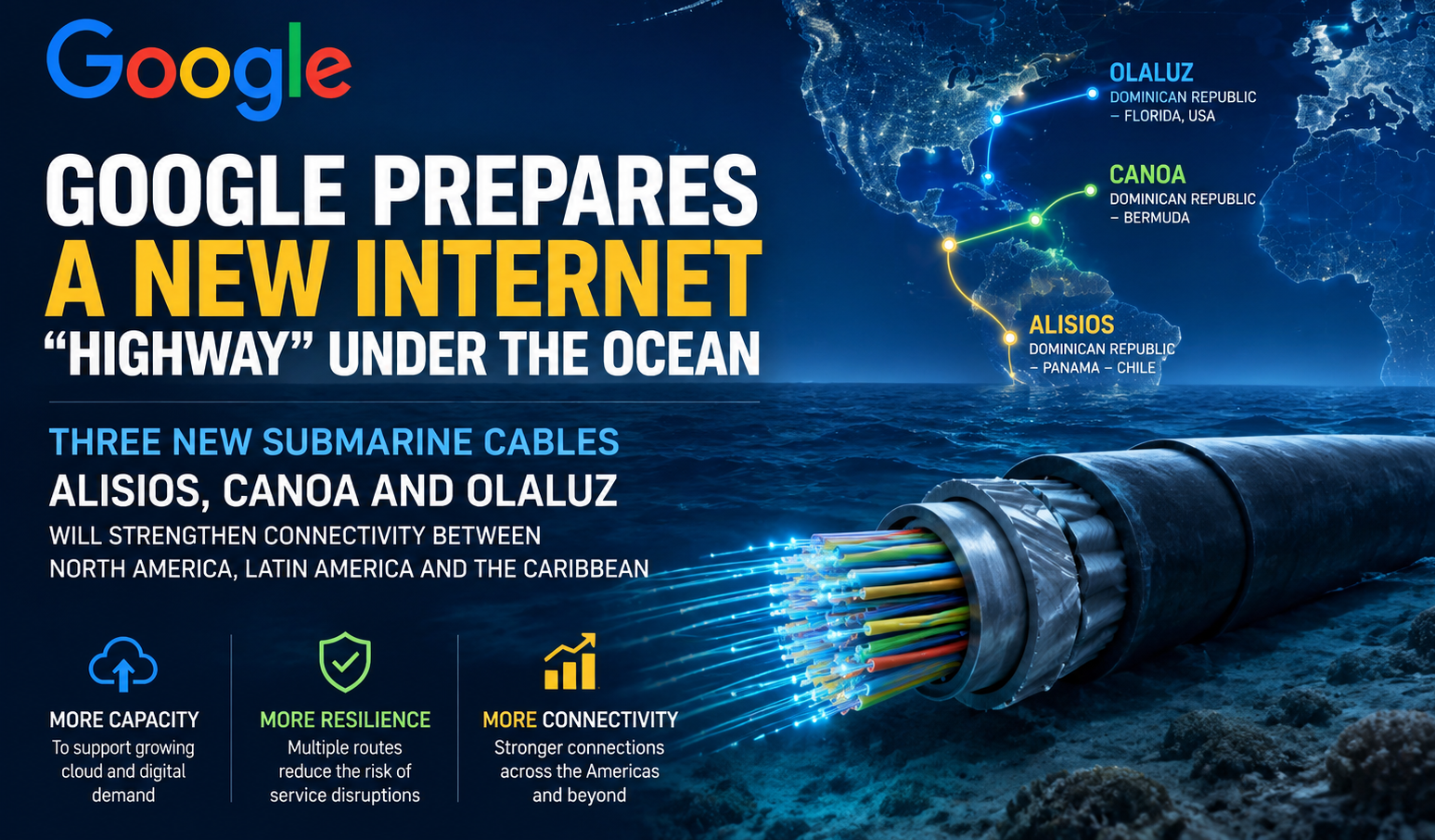
Google submarine cables are becoming increasingly important as the demand for faster, more reliable internet connectivity continues to grow. Google is expanding its digital infrastructure with three new submarine cable systems — Alisios, Canoa and OlaLuz — designed to strengthen connections across the Americas.
The new
Google submarine cables are part of a broader strategy to expand international network capacity and improve the resilience of digital infrastructure. These underwater fiber-optic systems are expected to support cloud computing, artificial intelligence, streaming, online services and other data-intensive technologies.
Google Is Building a New “Internet Highway” Under the Ocean
The infrastructure behind the global internet is about to receive a major expansion.
Google has announced three new submarine cable systems —
Alisios, Canoa, and OlaLuz — as part of its strategy to strengthen digital connectivity across the Americas. These systems are designed to create additional routes and capacity for moving data between North America, Latin America, and the Caribbean.
While many people associate the internet with satellites, mobile networks, and data centers, a significant portion of international internet traffic travels through fiber-optic
cables installed deep beneath the world’s oceans.
These submarine cables act like enormous digital highways, transporting huge volumes of information between continents.
As demand for cloud computing, artificial intelligence, video streaming, online services, and digital businesses continues to grow, the infrastructure carrying this information has become increasingly important.
Three New Submarine Cable Systems
Google’s new projects are called
Alisios, Canoa, and OlaLuz, with each system designed to strengthen different parts of the company’s network across the Americas.
The Alisios system is planned to connect the Dominican Republic with Panama and Chile, creating another important route between the Caribbean and South America.
The Canoa system will connect the Dominican Republic with Bermuda and will integrate with Google’s existing
Nuvem and Sol cable systems. This will create additional connectivity between the Caribbean, Latin America, North America, and Europe.
The third system,
OlaLuz, is planned to connect the Dominican Republic directly with Florida, increasing connectivity between the Caribbean and the United States.
Together, these projects are expected to provide additional network capacity and more diverse routes for digital traffic.
Why Are Submarine Cables So Important?
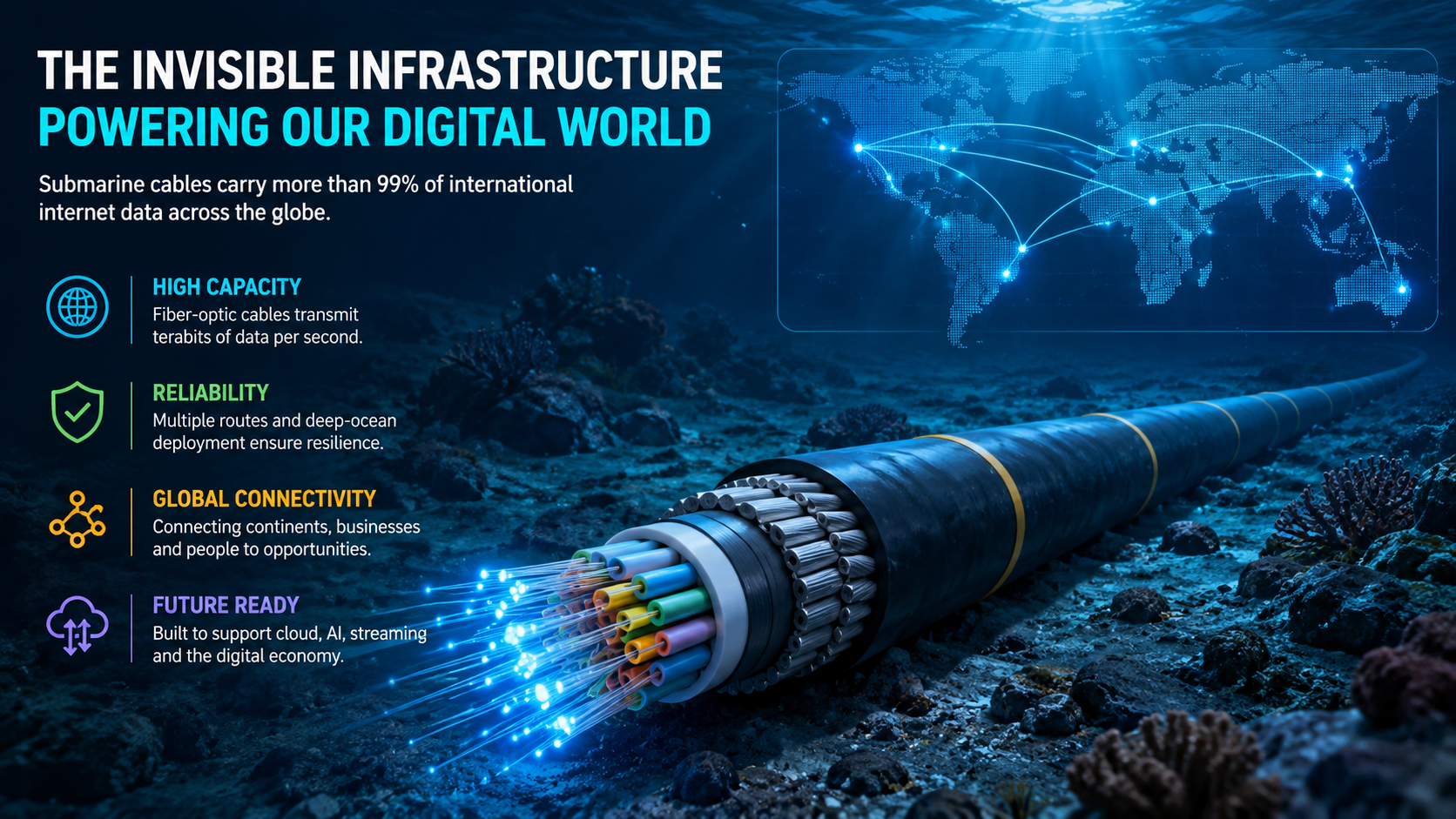
The importance of submarine cables becomes clearer when we consider how much of modern life depends on international data connections.
When someone watches a video hosted in another country, stores files in the cloud, joins an online meeting, uses an artificial intelligence service, or accesses an international website, data may travel thousands of kilometers through fiber-optic networks.
Submarine cables are responsible for carrying enormous amounts of this international traffic.
Adding more cables and alternative routes can help networks handle increasing demand while also improving resilience.
This is particularly important as businesses increasingly rely on cloud platforms, online applications, artificial intelligence, and other digital services.
Artificial Intelligence Is Increasing Demand for Infrastructure
One of the biggest forces behind the growing demand for digital infrastructure is
artificial intelligence.
Modern AI systems require enormous amounts of computing power and data. Companies need large data centers connected through high-capacity networks to deliver AI services to users around the world.
As AI adoption grows, the amount of information moving between users, data centers, cloud platforms, and businesses is also expected to increase.
This means that investments in physical infrastructure — including data centers, fiber networks, and submarine cables — are becoming just as important as investments in software.
Google’s expansion therefore reflects a broader technological trend:
the future of AI depends not only on powerful models but also on powerful networks capable of moving massive amounts of data.
More Routes Can Make the Internet More Resilient
Another major advantage of expanding submarine cable networks is
resilience.
If a region depends heavily on a single international cable route, damage to that cable can potentially affect connectivity.
Submarine cables can be damaged by several factors, including natural events, fishing activity, ship anchors, and other incidents.
Having multiple cable systems creates alternative routes for data traffic.
This means that if one route experiences an interruption, network operators may have other paths available.
For companies providing cloud services and other critical digital platforms, this redundancy can be extremely valuable.
Latin America Is Becoming More Important
One of the most interesting aspects of Google’s announcement is the increasing role of
Latin America and the Caribbean in global digital infrastructure.
The Alisios system will connect the Dominican Republic with Panama and Chile, while Canoa and OlaLuz will strengthen connections through the Caribbean and toward the United States.
This reflects the growing importance of Latin America in the global digital economy.
Countries across the region are experiencing increasing demand for cloud computing, online services, digital payments, artificial intelligence, e-commerce, and other technologies.
Better international connectivity can help businesses access global digital services and potentially support the expansion of technology-based industries.
Google’s Global Submarine Cable Strategy
The new projects are not isolated investments.
Google has already invested heavily in submarine cable infrastructure around the world.
The company has announced and participated in several major cable systems designed to connect different continents and regions.
One example is
Nuvem, a transatlantic system designed to connect the United States and Portugal through Bermuda and the Azores.
Another important project is
Sol, which is designed to connect Spain, the United States, Bermuda, and the Azores.
The addition of Alisios, Canoa, and OlaLuz therefore forms part of a much broader strategy.
Google is effectively building a network with multiple routes and high capacity, allowing its cloud and other digital services to operate across increasingly connected regions.
What Does This Mean for Internet Users?
Most internet users will probably never know exactly which submarine cable carries their data.
However, the impact of these investments can still be significant.
More capacity and additional routes can help support the continued growth of online services.
For consumers, this could contribute to better network resilience and the ability to support increasingly data-intensive applications.
For businesses, stronger international connectivity can be particularly important for cloud computing, remote work, financial technology, artificial intelligence, online commerce, and other digital services.
The impact will not necessarily appear as an immediate increase in internet speed for every user. Instead, the broader benefit is the creation of a stronger infrastructure capable of supporting future demand.
The Future of the Internet Is Also Under the Ocean
The development of Alisios, Canoa, and OlaLuz highlights an important reality about modern technology.
The future of the internet is not only being built inside smartphones, computers, applications, and artificial intelligence systems.
It is also being built
under the ocean.
Every search, video, cloud application, online transaction, AI request, and digital communication depends on a complex physical infrastructure operating behind the scenes.
As digital services continue to expand, companies will need more capacity, more connections, and more resilient networks.
Google’s new submarine cable projects demonstrate how technology companies are preparing for that future.
Conclusion
Google’s
Alisios, Canoa, and OlaLuz submarine cable projects represent another major step in the expansion of global digital infrastructure.
By creating additional connections between the Caribbean, Latin America, and North America, the projects are designed to increase capacity, improve network resilience, and support the growing demand for cloud computing and artificial intelligence.
The announcement also highlights the growing importance of Latin America and the Caribbean in the global digital economy.
The internet may appear to exist almost entirely in the digital world, but behind it is a massive physical infrastructure stretching across continents and beneath oceans.
The next generation of the internet may be powered by artificial intelligence, cloud computing, and advanced digital services — but underneath it all, the world’s submarine cables will continue to carry the data that makes it possible.