


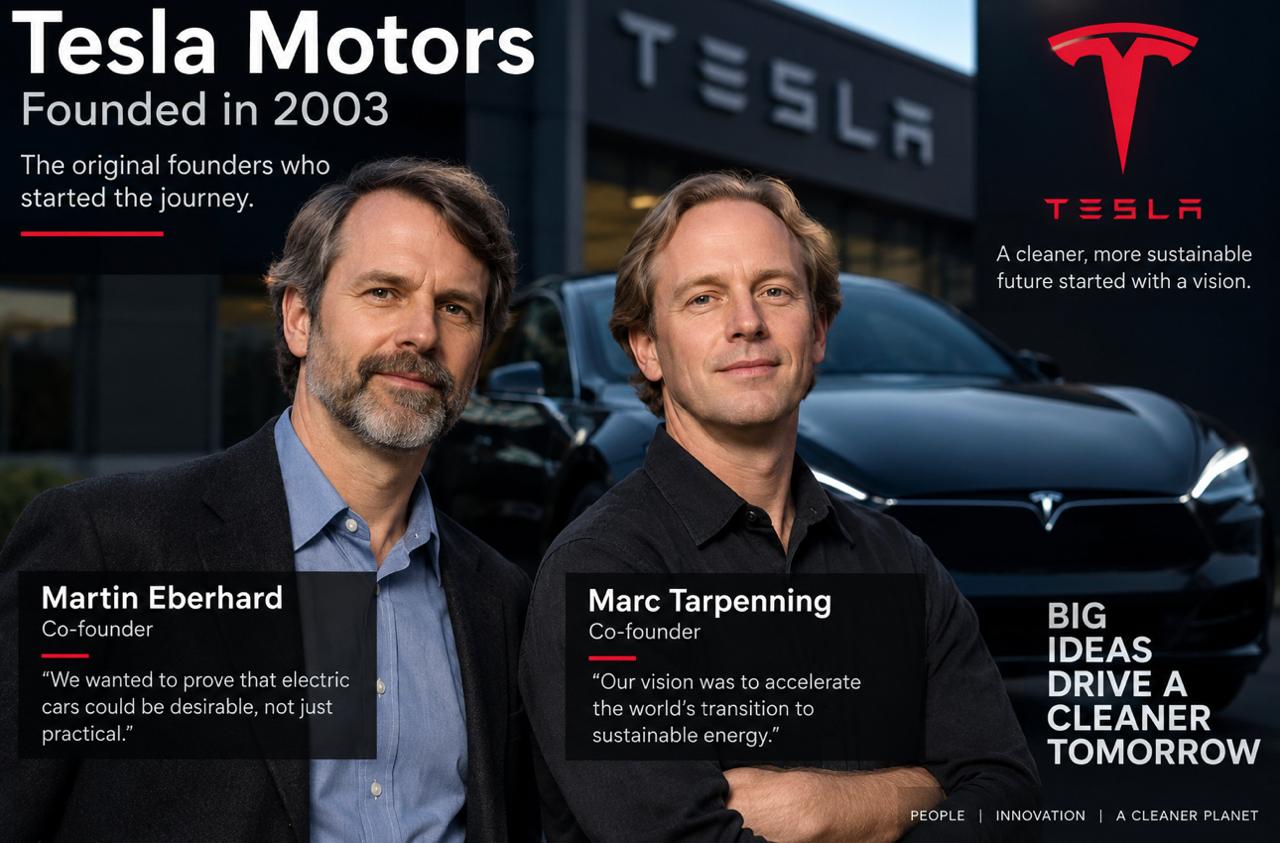
The Tesla founders, Martin Eberhard and Marc Tarpenning, started the company in 2003 with a bold idea: proving that electric cars could be exciting, desirable and commercially viable. Years later, Elon Musk would become the company’s most recognizable face.
When people think about Tesla, one name usually comes to mind almost immediately: Elon Musk.
Today, Musk is deeply associated with Tesla. He has been the company’s CEO since 2008 and has become one of the most recognizable figures in the global electric-vehicle industry. Tesla itself describes Musk as a co-founder and CEO.
But there is an interesting part of Tesla’s history that is often forgotten.
Tesla existed before Elon Musk joined the company.
Tesla Motors was incorporated on July 1, 2003, and Tesla’s own investor-relations information confirms that date. The company was founded by entrepreneurs Martin Eberhard and Marc Tarpenning, who were interested in building electric vehicles at a time when the idea of a desirable, high-performance electric car was still far from mainstream.
So, if Musk didn’t start Tesla in 2003, how did he become so central to the company’s story?
The answer is one of the most interesting chapters in Tesla’s history.
Tesla Before Elon Musk
Before Tesla became one of the world’s best-known technology and automotive companies, it was a much smaller startup with a very different identity.
Martin Eberhard and Marc Tarpenning had previously worked together and shared an interest in technology and alternative energy. Their vision was not simply to create another car company. They wanted to demonstrate that an electric vehicle could be desirable, technologically advanced and capable of competing with traditional cars.
Tarpenning’s own account of Tesla’s beginnings says that he and Eberhard founded Tesla in 2003 with the objective of developing high-end electric vehicles before eventually moving toward a larger market.
That vision was important because electric cars at the time were often associated with compromises.
The Tesla founders wanted to challenge that perception.
Instead of beginning with a cheap mass-market vehicle, the company focused on a sports car that could demonstrate what electric propulsion could achieve.
That vehicle eventually became the Tesla Roadster.
Then Elon Musk Entered the Story
Elon Musk joined Tesla after the company had already been incorporated.
In 2004, Musk became the company’s largest investor during its Series A funding round, contributing approximately $6.5 million of the $7.5 million raised and becoming chairman of Tesla’s board.
This was a major turning point.
Musk wasn’t simply a passive investor. His involvement became increasingly significant as Tesla developed its first vehicle and attempted to turn its electric-car concept into a real production company.
His financial backing gave Tesla crucial resources during its early development.
But money was only one part of the story.
Musk also became increasingly involved in product decisions, strategy and the company’s long-term ambitions. Over time, his influence grew substantially.
That is one reason why today’s Tesla is difficult to discuss without discussing Elon Musk.
From Startup to Global Brand
The Tesla of 2003 was a startup.
The Tesla associated with Musk today is a global automotive and energy company.
That transformation did not happen overnight.
The company’s first major product was the Roadster, which demonstrated that an electric vehicle could be positioned as a high-performance product rather than simply an environmentally friendly alternative.
The Roadster eventually entered production and was delivered to customers beginning in 2008.
But by then, Tesla had already experienced significant financial and engineering challenges.
Building a car proved considerably more complicated than building a software company.
Tesla had to deal with battery technology, manufacturing, engineering, supply chains, production delays and the enormous cost of bringing a new vehicle to market.
Musk eventually became Tesla’s CEO in October 2008, a position he still holds today.
From that point forward, Musk’s public identity became increasingly connected with Tesla.
So, Who Really Founded Tesla?
This is where the story becomes more complicated.
If we look strictly at the company’s incorporation, Tesla was incorporated in July 2003 by Martin Eberhard and Marc Tarpenning. Musk joined the company later, in 2004.
But that doesn’t mean the story ends there.
Tesla’s founder history eventually became the subject of a legal dispute involving Eberhard and Musk.
In 2009, Tesla stated that it believed in a team of founders, including Elon Musk and J.B. Straubel, and the dispute ultimately resulted in an arrangement under which five people could identify themselves as Tesla co-founders: Martin Eberhard, Marc Tarpenning, Ian Wright, Elon Musk and J.B. Straubel.
That distinction is important.
There is a difference between asking:
Who incorporated Tesla?
and asking:
Who can legitimately be called a Tesla co-founder?
The first question has a relatively straightforward historical answer.
The second is much more complicated.
Why Elon Musk Became the Face of Tesla
Regardless of how people interpret the founder question, Musk played a major role in Tesla’s development after joining the company.
He became chairman, invested substantial amounts of his own money, became increasingly involved in the company’s strategy and eventually took over as CEO.
As Tesla expanded beyond the Roadster and introduced vehicles such as the Model S, Model X and Model 3, Musk’s public profile became increasingly connected with the company’s success. Tesla’s official biography identifies him as co-founder and CEO and credits him with leadership across product design, engineering and manufacturing.
This helps explain why many people instinctively believe Musk created Tesla.
For much of the public, the person who transforms a startup into a global company becomes almost synonymous with its creation.
But corporate history can be more complicated than public perception.
The Forgotten Founders
Martin Eberhard and Marc Tarpenning don’t have the same global visibility as Elon Musk today.
Nevertheless, their role in Tesla’s origins is significant.
They were the entrepreneurs who established Tesla Motors in 2003 and developed the early vision that electric cars could become desirable products rather than simply practical alternatives.
Their story also highlights something important about startups:
The person who starts a company is not always the person who eventually becomes its most famous leader.
Companies evolve.
Investors arrive.
Executives change.
Ideas develop.
And sometimes the person who becomes the public face of a company joins after the original founders have already taken the first steps.
Tesla is a fascinating example of exactly that process.
The Real Tesla Story Is Bigger Than One Person
It is tempting to reduce Tesla’s history to a simple statement:
“Elon Musk founded Tesla.”
It is equally simplistic to say:
“Elon Musk had nothing to do with creating Tesla.”
Neither statement captures the full story.
Tesla existed before Musk’s involvement, and Eberhard and Tarpenning were responsible for incorporating the company in 2003. At the same time, Musk became a major early investor, chairman, strategic force and eventually CEO. The company’s later history cannot reasonably be separated from his leadership.
The more accurate story is therefore more interesting.
Tesla began as an ambitious startup founded by Eberhard and Tarpenning. Elon Musk entered the story shortly afterward, invested heavily and became increasingly influential in transforming the company into the global brand we know today.
And that is precisely why the Tesla founder debate continues to attract attention.
What Do You Think?
The history raises an interesting question:
Should Elon Musk be considered one of Tesla’s founders, even though he joined after the company was incorporated?
Or should the title of founder belong primarily to the people who created the company before Musk became involved?
There is a strong argument on both sides.
The historical record shows that Tesla existed before Musk. But it also shows that Musk became deeply involved in the company during its earliest years and played a major role in its subsequent development.
Perhaps the better question isn’t simply “Who founded Tesla?”
Perhaps it is:
“Who helped turn Tesla from an idea into the company the world knows today?”
That question gives us a much more interesting story.
