


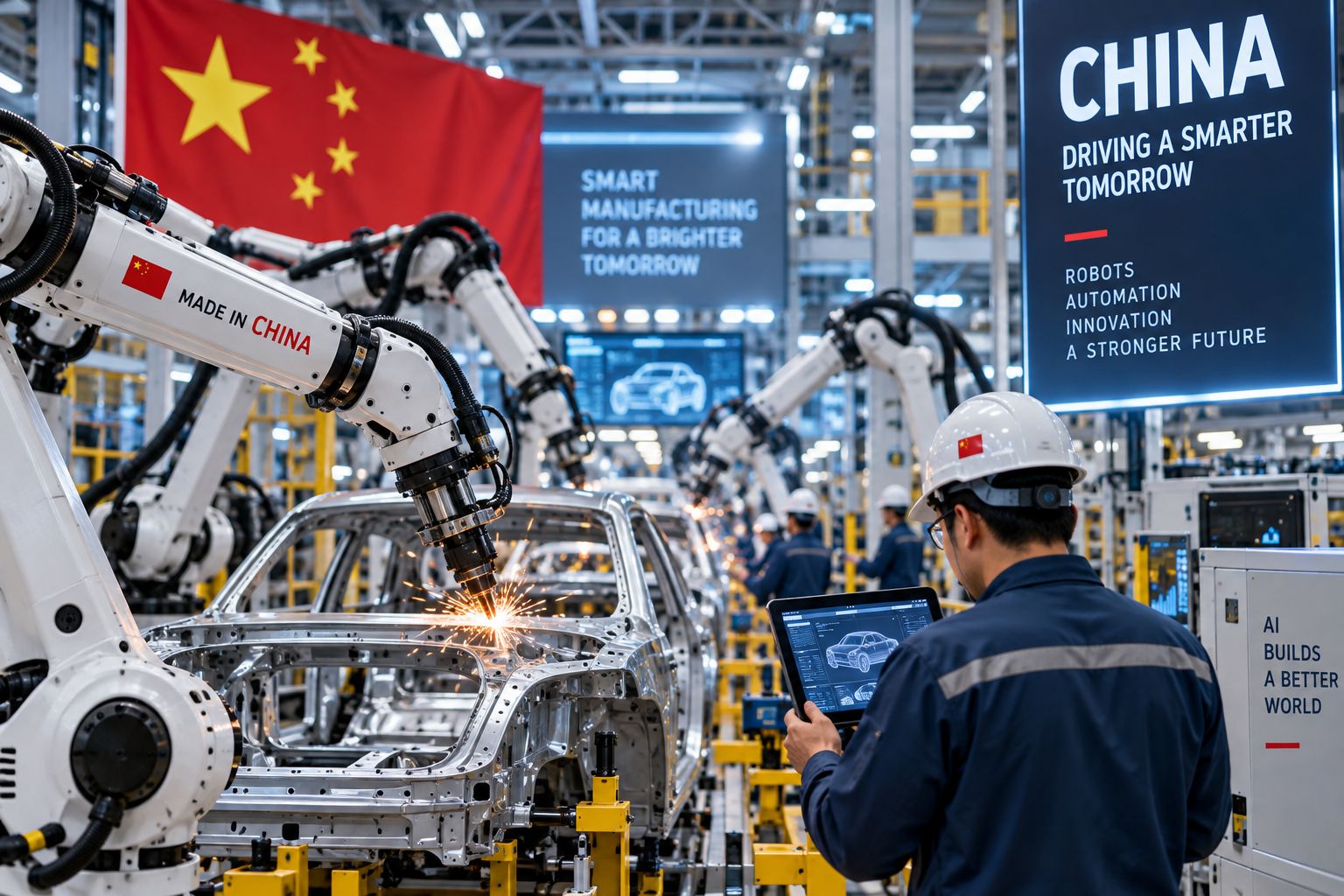
China robotics revolution is changing the way factories operate, with industrial robots increasingly taking on repetitive tasks and reshaping the future of manufacturing.
China’s robotics revolution is changing manufacturing faster than many people realize. While humanoid robots attract much of the attention, industrial machines are already reshaping factories, production and the future of work.
China has built a huge ecosystem around industrial automation, and purpose-built machines are already handling tasks that once depended heavily on human labor. Robotic arms can weld, paint, move components, inspect products and repeat precise operations for long periods. Unlike humanoids, these systems do not need to imitate the human body. They are designed around specific jobs, making them easier to deploy and, in many cases, more practical.
The scale is significant. China installed about 295,000 industrial robots in 2024, representing roughly 54% of global installations, according to recent reporting. The country also had more than two million industrial robots in operation, showing how deeply automation has already entered manufacturing.
This shift is also connected to China’s changing workforce. The country is facing an aging population and growing pressure on manufacturers to maintain productivity while finding enough workers. Automation can help companies deal with repetitive tasks and labor shortages, but it also raises difficult questions about employment and the skills workers will need in the future.
Humanoid robots are still part of this transition because their human-like shape could allow them to work in environments designed for people. Chinese companies are investing heavily in embodied artificial intelligence, training robots to understand physical spaces and perform tasks that require vision, movement and interaction with objects. However, current humanoids still face major challenges involving reliability, dexterity, speed and cost.
That is why specialized robots may remain more important in the near term. A machine built specifically to inspect a component or move material does not need to walk, balance or understand an entire factory. It only needs to perform its assigned task reliably and at a competitive cost.
China is also trying to shorten the distance between robotics research and mass production. New facilities are being developed to manufacture humanoid robots at larger volumes, while training centers are collecting data from real-world tasks. The long-term ambition is not simply to build more robots, but to create an ecosystem where artificial intelligence, manufacturing and robotics reinforce each other.
This could eventually lead to factories where robots manufacture products and increasingly help manufacture other robots. Yet the transition is unlikely to mean that humans disappear from industrial workplaces overnight. Maintenance, quality control, programming, supervision and system development will remain important, even as the nature of factory work changes.
The most important robotics revolution, therefore, may not look like science fiction. It may look like an ordinary production line becoming faster, more automated and less dependent on repetitive human labor.
For workers, businesses and governments, the challenge is preparing for that change. The question is no longer simply whether robots will enter the workplace. They already have. The bigger question is which skills will remain valuable when machines become capable of handling an expanding share of physical work.
For the global economy, China’s approach could have consequences far beyond its own factories. As production costs fall and robotic systems become easier to obtain, manufacturers in other countries may face pressure to automate as well. That could reshape supply chains and increase demand for technical specialists.
There is also an important distinction between replacing workers and changing their jobs. In many factories, automation removes repetitive or physically demanding steps while leaving people responsible for decisions, troubleshooting and oversight. The result may be fewer traditional production roles, but more demand for workers who understand machines, software and data.
The quiet robotics revolution is therefore already underway. Humanoids may dominate the headlines, but industrial automation is where much of the economic impact is being created today.
