


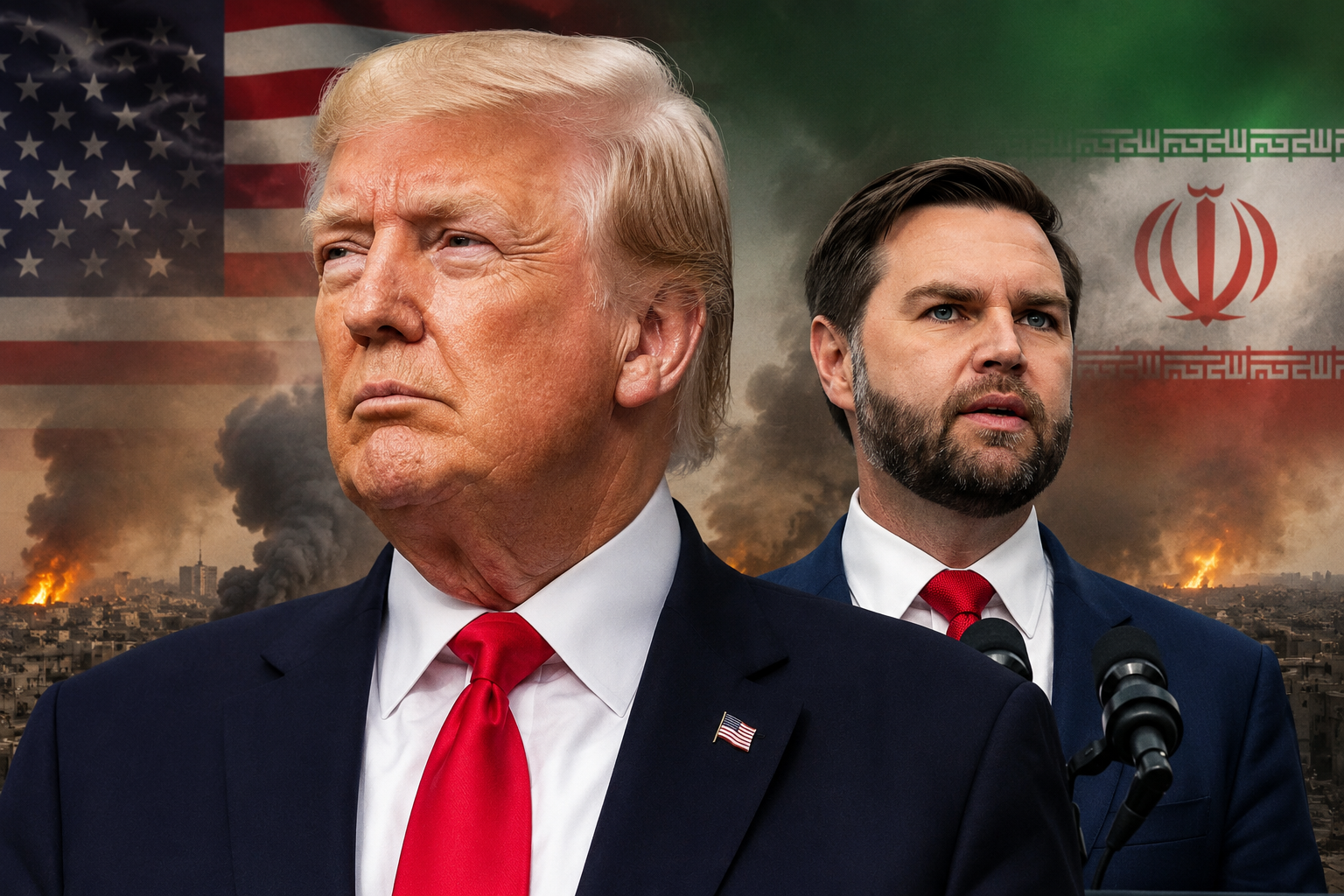
Trump Faces Political Pressure as JD Vance Defends U.S. Strategy
Trump approval rating has become a growing political concern as the U.S. president faces increasing pressure at home while the conflict in the Middle East continues.Donald Trump is facing one of the most difficult political moments of his second presidency as his approval ratings continue to decline while the United States remains deeply involved in the conflict with Iran.
Recent polling and political analysis indicate that only around one-third of Americans currently approve of Trump’s performance, with the economy, rising costs and the war in Iran contributing to growing dissatisfaction. (The Times)
At the same time, Vice President JD Vance has presented a significantly more confident assessment of the situation. According to comments highlighted by CNN Portugal, Vance said that the United States could ultimately emerge from the conflict in a stronger position.
The contrast is striking: while Trump faces increasing pressure from voters at home, his administration continues to argue that its strategy in the Middle East can produce important gains for the United States.
Trump’s Approval Ratings Become a Major Political Problem
Approval ratings are becoming an increasingly important issue for the Trump administration.
The latest political environment is particularly challenging because the United States is approaching the 2026 midterm elections. Rising living costs, gasoline prices and dissatisfaction with the administration’s handling of the Iran conflict are creating additional pressure on Republicans. (Le Monde.fr)
Recent reporting has described Trump’s approval rating as being at or near historic lows. One recent poll reported support at roughly one in three Americans, marking one of the weakest points measured during either of his terms. (News.com.au)
For Trump, this creates a difficult political equation.
A president can argue that an international strategy is successful, but voters ultimately judge the administration based on whether they believe that strategy is improving their lives.
If the conflict continues to push energy prices higher or creates additional economic uncertainty, the political consequences could become even more significant.
JD Vance Says the United States Could Emerge Stronger
Despite the political difficulties, JD Vance has maintained a more optimistic assessment of America’s strategic position.
The vice president has argued that Washington’s objective is not simply to engage in military confrontation, but to use a combination of military pressure, economic measures and diplomacy to force Iran to make concessions.
That argument is central to the administration’s broader message.
From Washington’s perspective, a successful outcome would involve reducing the threat posed by Iran’s nuclear capabilities, protecting American interests and restoring greater stability to strategically important energy routes.
Recent developments have also shown that the administration is increasingly focused on economic pressure and energy markets. Reports indicate that lowering oil prices has become an important priority for Washington as the conflict continues. (Al Arabiya English)
Iran Remains at the Center of the Crisis
Iran remains one of the most important factors in determining how the conflict develops.
The confrontation has implications far beyond Washington and Tehran because the Middle East remains crucial to global energy supplies.
The Strait of Hormuz is particularly important. Any prolonged disruption to shipping through the strategic waterway could affect oil and gas markets around the world.
That means the conflict is not only a military and diplomatic issue. It is also an economic issue.
Higher energy prices could increase inflationary pressure in countries far outside the region, making the consequences of the conflict global.
What Does “A Stronger Position” Mean?
JD Vance’s statement that the United States could emerge from the conflict in a stronger position should not necessarily be interpreted as a prediction that the war will simply end with an American military victory.
A stronger position could mean several different things.
It could mean that Washington achieves important diplomatic concessions from Tehran. It could mean that the United States strengthens its leverage over Iran while avoiding a prolonged ground war. It could also mean protecting major international shipping routes and reducing the risk of Iran developing a nuclear weapon.
The administration therefore has several possible ways to define success.
The biggest challenge will be turning those strategic objectives into measurable results.
The Political Risk for Trump
The conflict creates an unusual political situation for Donald Trump.
If the administration achieves a diplomatic breakthrough, stabilizes energy markets and demonstrates that Iran has been significantly weakened, Trump could present the outcome as evidence that his foreign-policy strategy worked.
That could help him politically.
However, the opposite scenario could be damaging.
If the conflict continues without a clear resolution, if energy prices remain elevated or if American military involvement expands, public dissatisfaction could increase.
The political pressure could become even stronger as the midterm elections approach.
Recent reporting has already highlighted the political backlash surrounding Trump’s handling of the Iran conflict. (The Wall Street Journal)
A Different Message From the White House
The difference between Trump’s political numbers and Vance’s strategic assessment illustrates a broader challenge for the White House.
The administration needs to convince Americans that the costs associated with the conflict are justified by the results.
That means Washington will have to demonstrate progress rather than simply describe the United States as being in a strong position.
For JD Vance, the argument is essentially that the United States can use the current crisis to strengthen its strategic position.
For Trump’s political future, however, the question is whether American voters will agree.
What Happens Next?
The coming weeks could be critical.
Diplomatic negotiations, developments involving Iran, the situation around the Strait of Hormuz and movements in global energy markets could all influence the direction of the conflict.
At the same time, Trump’s approval ratings will remain an important indicator of how Americans are responding to his policies.
If the administration can demonstrate concrete results, the political situation could improve.
If the conflict continues without a clear resolution, however, the pressure on Trump could become even greater.
For now, the United States is facing two different battles at the same time: one abroad and another at home.
JD Vance believes Washington can emerge from the Middle East crisis stronger.
But Donald Trump still has to convince American voters that the strategy is working.
And with approval ratings at historically weak levels, that may prove to be one of the administration’s biggest challenges.
