


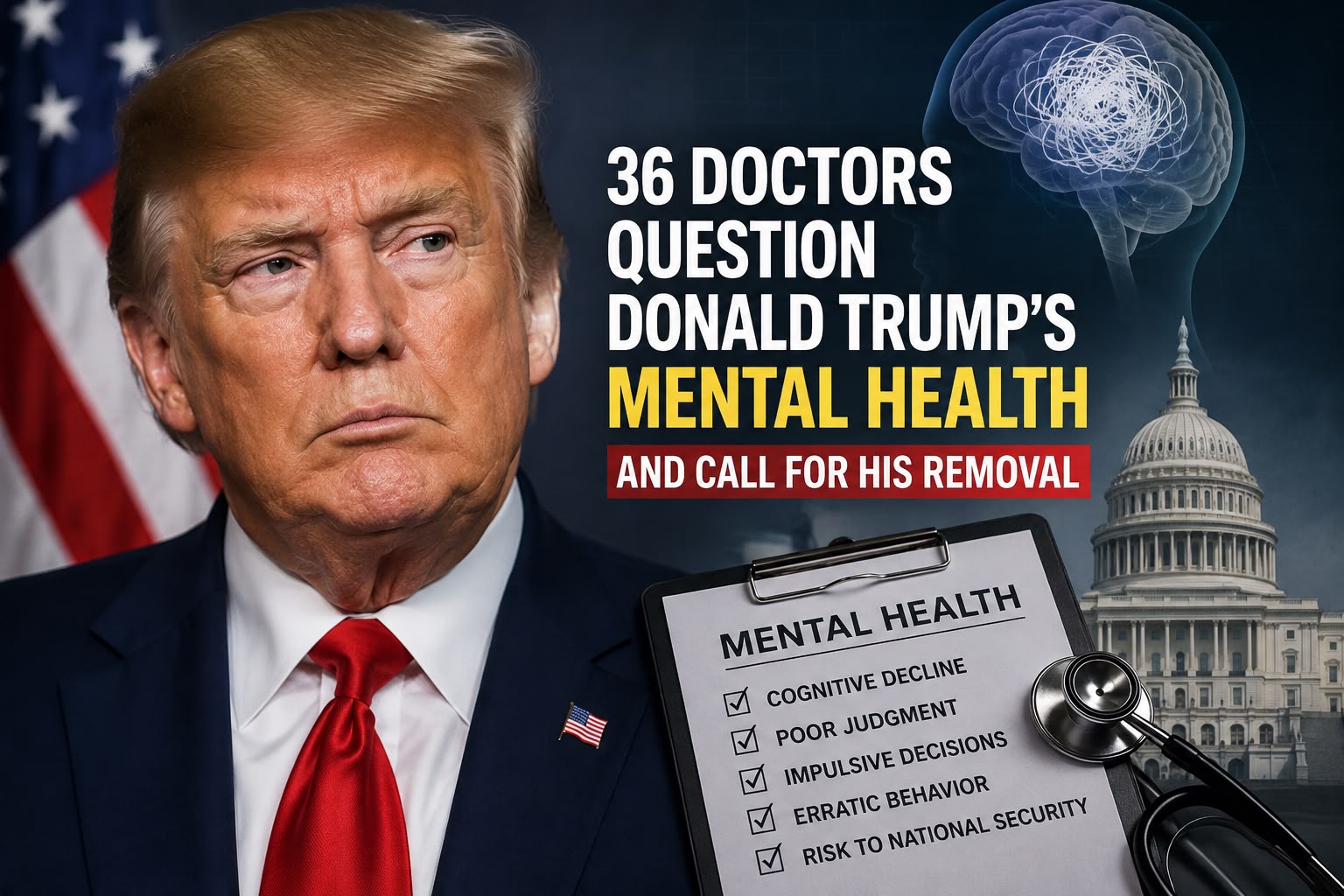
36 Doctors Raise Concerns About Donald Trump’s Mental Health
Donald Trump mental health concerns have become the focus of a new political and professional debate after 36 doctors and mental health professionals raised questions about the president’s cognitive functioning, judgment and ability to perform the demanding responsibilities of the White House.
A statement signed by 36 doctors and other professionals with experience in mental health has renewed the debate over Donald Trump’s ability to perform the demanding responsibilities of the US presidency.
The group says it has observed patterns in Trump’s public behavior that it considers concerning, particularly in relation to judgment, cognitive functioning and decision-making. Their intervention has attracted attention because of the enormous authority held by the president of the United States, particularly in areas involving national security and military decisions.
The statement was presented publicly in 2026 and entered the Congressional Record, bringing the issue into a broader political and institutional discussion.
What Are the Doctors Concerned About?
According to the statement, the professionals say they have observed behaviors that they believe warrant closer attention.
Among the issues discussed are what they describe as increasingly disorganized or repetitive speech, apparent confusion about facts, impulsive decisions and changes in positions on important matters.
The doctors argue that these observations should not simply be dismissed as ordinary political behavior because the person involved occupies one of the most powerful positions in the world.
Their concern is particularly focused on whether a president can consistently demonstrate the judgment, concentration and cognitive abilities necessary to make extremely consequential decisions.
Did the Doctors Diagnose Donald Trump?
This is an important distinction when discussing the story.
The doctors did not conduct a direct clinical examination of Donald Trump.
The professionals involved are not presenting their statement as a conventional medical diagnosis based on a doctor-patient relationship. Instead, they say their concerns are based on publicly observable behavior, speeches, interviews and other information available to the public.
That distinction matters because diagnosing a person’s mental or cognitive condition without personally evaluating that individual is medically and ethically controversial.
Therefore, the statement should be understood as a public professional warning rather than proof of a specific medical diagnosis.
Why Does Presidential Mental Health Matter?
The debate becomes particularly significant because of the responsibilities associated with the US presidency.
The president has authority over major national-security decisions and serves as commander in chief of the US military. The office also involves decisions that can affect international relations, financial markets, military operations and millions of people around the world.
For the doctors who signed the statement, this level of responsibility makes questions about cognitive functioning and judgment especially important.
They argue that concerns about a president’s ability to perform his duties should not automatically be treated as a partisan political issue.
Doctors Call for Action
The statement goes beyond simply raising concerns about Trump’s behavior.
The signatories argue that constitutional mechanisms should be considered if a president is unable to adequately perform the duties of the office.
Their position has generated controversy because removing an elected president is an extraordinary political and constitutional step.
The discussion therefore involves much more than Trump’s personal health. It touches on questions about presidential power, constitutional safeguards and how democratic institutions should respond when concerns arise about a leader’s ability to govern.
The Ethical Debate Around Public Mental Health Assessments
The controversy also highlights a long-standing debate within psychiatry and psychology.
Mental health professionals generally face ethical questions when commenting publicly on the mental condition of people they have not personally examined.
Supporters of statements like this argue that professionals may have a responsibility to speak out when they believe public safety could be at stake.
Critics, however, can argue that publicly interpreting a politician’s behavior without a direct examination risks turning medical expertise into a political weapon.
The distinction between raising professional concerns and making a clinical diagnosis is therefore extremely important.
In Trump’s case, the doctors have emphasized that they are raising concerns based on publicly available evidence rather than claiming to have personally diagnosed him.
A Debate That Extends Beyond Donald Trump
The controversy surrounding Trump’s mental health is part of a larger international debate about the physical and cognitive fitness of political leaders.
Presidents and prime ministers often remain in office well into older age, making questions about memory, judgment and decision-making increasingly relevant.
The issue is not limited to one political party or one country. Democratic systems must balance a leader’s right to privacy with the public’s interest in knowing whether that leader can safely and effectively perform the duties of office.
That balance becomes particularly difficult when accusations about a politician’s health become part of an intensely polarized political environment.
What Happens Next?
The statement signed by the 36 professionals does not automatically remove Donald Trump from office.
Any formal action concerning a president’s ability to serve would have to follow the constitutional and political mechanisms established in the United States.
For now, the doctors’ statement primarily adds another layer to an already intense public debate about Trump’s leadership, behavior and capacity to perform his presidential responsibilities.
It is also important for readers to distinguish between professional concerns, political claims and medically confirmed diagnoses.
The statement represents the views of its signatories. It should not be interpreted as independent medical confirmation of a specific psychiatric or neurological disorder.
Conclusion
The statement signed by 36 doctors and mental health professionals has reignited questions about Donald Trump’s mental and cognitive fitness for the presidency.
The professionals argue that certain patterns in Trump’s public behavior deserve serious attention and believe that constitutional safeguards should be considered if a president becomes unable to perform the duties of office.
At the same time, the doctors did not personally examine Trump, meaning their statement is not equivalent to a formal clinical diagnosis.
The controversy raises a broader question for American democracy: How should institutions respond when credible professionals raise concerns about the ability of a powerful political leader to perform one of the world’s most demanding jobs?
As the debate continues, separating verified facts from political interpretation will remain essential.
